Triadic Memories - 2022
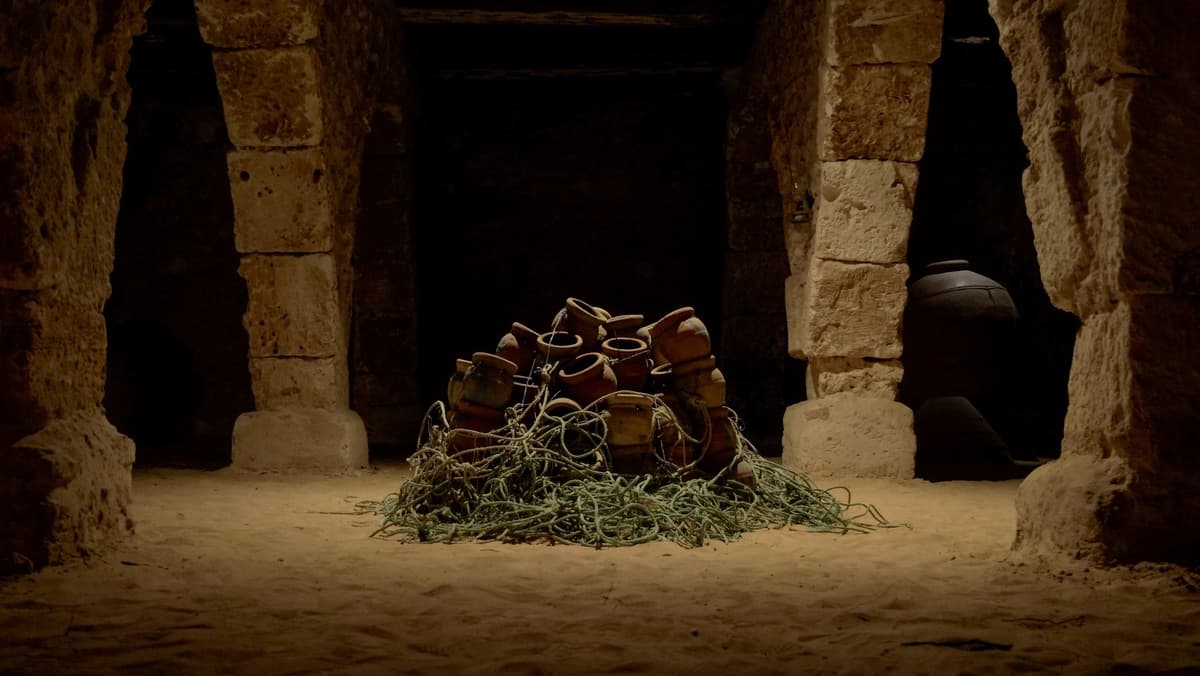
Triadic Memories is a video installation that includes a video work of the same name, created in 2004, when Chaddad returned for the first time to his hometown, Djerba, since leaving as a child. Alongside the video, approximately 100 amphoras are displayed, each inscribed with Judeo-Tunisian writing.
Preceeded by anti-Semitic pogroms of the late 14th century, the expulsion of Jews from Spain was prompted by the Alhambra Decree in 1492; at this time, Chaddad's paternal family left Gibralter for Algiers, and took part in the Andalusian Jewish and Muslim migration through North Africa, eventually settling on the island of Djerba, where they would build the Jewish ghetto of Hara Kbira in the beginning of the 15th century. This new Jewish settlement was built six kilometers away from the historical Jewish community of Hara Sghira, where Chaddad's maternal family resided for millenia.
Tensions against Jews in North Africa rose in the 20th century, which led Chaddad's family to migrate from Djerba to Jerusalem the late 1970s; young Chaddad left his birthplace for what became four decades, leaving one home to take root in another, and participating in a pattern of migration and settlement common in the Jewish community. Since his return to Tunisia at the age of 39, Chaddad is routinely greeted by non-Jewish Tunisians with the phrase, “Welcome to Tunisia.” In Triadic Memories, Chaddad responds, and gives space to the powerful question posed to the Jewish diaspora by those that perceive themselves to be indigenous, whether in Djerba or Jerusalem: “When did you come back?”
Situated in a reconstructed pottery workshop, a jarroush, or mound of traditional clay amphoras, are connected by dolly rope and painted with the aforementioned question, “When did you come back?” written in Chaddad's mother tongue of Judeo-Tunisian, “וקטאץ רזאעת,” and pronounced “Waktech rjat?” The interior of each amphora is painted black, mimicking a technique used by Mediterranean fishermen to catch octopi, luring them into a compact, dark space resembling the natural coves and coral where the species finds refuge and desired territory. As migratory animals, octopi are seduced by the safety of the amphoras, and settle into a deceptive trap that is fabricated to feel like home. Triadic Memories (2004), a video created by Rafram upon his first return to Djerba since leaving home as a child, is projected on a wall behind the collection of amphoras.
Triadic Memories, 2004
Tensions against Jews in North Africa rose in the 20th century, which led Chaddad's family to migrate from Djerba to Jerusalem the late 1970s; young Chaddad left his birthplace for what became four decades, leaving one home to take root in another, and participating in a pattern of migration and settlement common in the Jewish community. Since his return to Tunisia at the age of 39, Chaddad is routinely greeted by non-Jewish Tunisians with the phrase, “Welcome to Tunisia.” In Triadic Memories, Chaddad responds, and gives space to the powerful question posed to the Jewish diaspora by those that perceive themselves to be indigenous, whether in Djerba or Jerusalem: “When did you come back?”
Situated in a reconstructed pottery workshop, a jarroush, or mound of traditional clay amphoras, are connected by dolly rope and painted with the aforementioned question, “When did you come back?” written in Chaddad's mother tongue of Judeo-Tunisian, “וקטאץ רזאעת,” and pronounced “Waktech rjat?” The interior of each amphora is painted black, mimicking a technique used by Mediterranean fishermen to catch octopi, luring them into a compact, dark space resembling the natural coves and coral where the species finds refuge and desired territory. As migratory animals, octopi are seduced by the safety of the amphoras, and settle into a deceptive trap that is fabricated to feel like home. Triadic Memories (2004), a video created by Rafram upon his first return to Djerba since leaving home as a child, is projected on a wall behind the collection of amphoras.
Triadic Memories, 2004
Photos by Zied Haddad
Curatorial text by Katherine Li Johnson
Curatorial text by Katherine Li Johnson
Triadic Memories (2004), aspect ratio 16:9, 2:52 minutes, one video projector, amphoras, paint, fishing rope
Contact me for questions and price list.
Lalla Hadria Museums, 2022